The most beautiful drive from Porto to Lisbon (or the other way round)
Landing at Porto (OPO) and dropping the rental car at Lisbon (LIS), or driving the other way? We mapped two beautiful routes between the two cities: along the coast via the beach chapel of Miramar, the striped houses of Costa Nova and the giant waves of Nazaré, or inland via Coimbra, Fátima and the monasteries of Tomar and Batalha. The A1 rushes through in just over three hours; these routes turn the drive into a day of holiday.
Two routes: pick the coast or inland
Both beautiful, both in both directions. Pick your route and open it straight away in Google Maps, or download the GPX.
Along the coast
RecommendedOcean, fishing villages and the Estrada Atlântica: the classic, done properly.
Inland past the monasteries
Buçaco, Coimbra, Tomar, Fátima and Batalha: three UNESCO sites in one day.
Two days? Drive out along the coast and back inland (or the other way).


Photos via Wikimedia Commons: Costa Nova by Xosema (CC BY-SA 4.0), Batalha by Cardilio (CC BY-SA 4.0), Nazaré by GualdimG (CC BY-SA 4.0).
Beautiful twice over: the coast or inland
The fastest way from Porto to Lisbon is the A1: just over three hours of toll motorway through the interior, with little to look at but crash barriers. We mapped two far better alternatives. The coastal route follows the Atlantic: from the chapel on the beach at Miramar via the canals of Aveiro, the striped houses of Costa Nova and the Estrada Atlântica to the giant waves of Nazaré and the walled town of Óbidos. The inland route strings together the great stories of central Portugal: the forest of Buçaco, the university city of Coimbra, the schist village of Talasnal, the Templar stronghold of Tomar, the sanctuary of Fátima and the monastery of Batalha. Three UNESCO World Heritage Sites in a single day.
It is a fly-drive corridor par excellence: you land at one airport, pick up your rental car and drop it at the other. Pick your route and direction below; every stop is already in the Google Maps link, and there is a GPX for each drive.
Coast or inland: the routes compared
| Along the coast | Inland | |
|---|---|---|
| Distance | approx. 370 km | approx. 445 km |
| Pure driving time | approx. 5 h 45 | approx. 7 h |
| Motorway share | approx. 25%, only the final leg after Óbidos | approx. 45%, the run-in and the finish |
| Number of stops | 8 | 6 |
| Character | ocean, fishing villages, dunes, a chapel on the beach | UNESCO monasteries, a world pilgrimage site, a schist mountain village, forest |
| Finest roads | the Gaia seafront, the Estrada Florestal 1 through the dunes near Mira, the Estrada Atlântica (N242) | the N234 through the Buçaco forest, the climb to Talasnal, the rolling roads around Tomar |
| Best for | first visit, photo stops, beaches, with children | culture and history, quiet roads, a second visit |
Good to know (applies to both routes)
| Tolls and transponder | the A1, A8, A14, A17 and A29 are toll roads; the A1 Porto to Lisbon costs about 25 euros for a car (2026 tariff). The coastal A17 and the A29 have no toll booths, only number-plate cameras: rent a toll transponder (Via Verde) with the car or register your plate in advance. The coastal route runs almost toll-free until Óbidos |
|---|---|
| Toll-free since 2025 | many other Portuguese motorways (A22, A23, A24, A25, A4, A13) have been toll-free since 1 January 2025, but none of them lie on this corridor, so do not count on it here |
| Fuel (estimate) | coast approx. 28 litres, inland approx. 33 litres at 7.5 l/100 km; reckon on 50 to 65 euros (fuel prices vary) |
| One-way rental | picking up at Porto and dropping off at Lisbon (or the reverse) is normal within Portugal and usually cheap; check the one-way fee and whether you return the car at the airport or in the city |
| Best time to go | May, June, September and October; in July and August the coast is packed. The giant waves of Nazaré are mostly a winter spectacle, and around 13 May and 13 October hundreds of thousands of pilgrims fill Fátima |
| Suitable for | rental car, convertible, motorbike and camper; with a camper, mind the narrow core of Óbidos and park below the village at Talasnal |
Toll status per motorway and the toll abolition on the former toll roads as of 1 January 2025: Portuguese toll information, checked 11 July 2026; the A1 figure is the 2026 car tariff. Distance and driving time per route are measured with the stops as waypoints (OSRM, July 2026). Fuel is a calculation with stated assumptions; prices vary.
Always check road signs, current closures and local rules along the way.
Who is this route for
For anyone landing at Porto or Lisbon with a rental car who would rather not spend three hours on a toll motorway. The coastal route is the one to pick for a first visit: ocean, fishing villages, photo stops and a day that runs itself. The inland route is for lovers of history and quiet roads: three UNESCO sites, a world-class pilgrimage site and a mountain village built of schist. Both drive just as well in an ordinary rental car as in a convertible or on a motorbike.
The two routes in detail
Along the coast
From Porto you head straight for the sand along the Vila Nova de Gaia seafront: at Miramar the chapel of Senhor da Pedra stands literally on the rocks in the surf. Then you follow the Costa de Prata: the canals of Aveiro, the striped palheiros of Costa Nova and the dune road to Praia de Mira, a narrow ribbon of asphalt between ocean and pines. After the broad beach of Figueira da Foz comes the best-known stretch: the Estrada Atlântica (N242) to São Pedro de Moel and the giant waves of Nazaré. You finish in walled Óbidos; only that last hour to Lisbon is motorway.
Along the way you pass more than fits in a Maps link: the shell-shaped bay of São Martinho do Porto (ten minutes after Nazaré on the N242) and the UNESCO monastery of Alcobaça are both a short detour off the route. Switch on "Avoid tolls" in Google Maps for this route: the app then keeps to the coastal roads and the driving time above holds. In reverse, from Lisbon to Porto, you start in Óbidos ahead of the coaches and save the beach chapel of Miramar for the evening light.
The 8 stops along the coast

1. Senhor da Pedra (Miramar)
On the rocks in the middle of Miramar beach stands the centuries-old chapel of Senhor da Pedra, with the ocean on three sides; the spot is said to have been a shrine long before Christianity. It is one of the most photographed places on the Portuguese coast and a perfect first stop, less than half an hour from the rental desk. At high tide the waves reach the steps.
Practical: park by the Miramar seafront and walk the last stretch across the sand or the boardwalks. Early in the morning you have the chapel to yourself.

2. Aveiro
Aveiro sits on a lagoon full of canals, plied by the brightly painted moliceiro boats once used to harvest seaweed. Walk along the Canal Central with its Art Nouveau facades, taste the ovos moles (a local sweet) and perhaps take a short trip on a moliceiro. The next stop, Costa Nova, is ten minutes away by the sea.
Practical: park near the centre and walk along the canals; a boat trip takes about three quarters of an hour.
3. Costa Nova
The palheiros of Costa Nova are the postcard of this coast: wooden houses in bold red, green and blue stripes, once stores for nets and tackle, painted brightly so fishermen could spot them from the lagoon in the sea mist. They stand on a narrow spit between the Ria de Aveiro and the ocean; over the dunes waits a beach that runs for kilometres, and at Barra just up the road stands the tallest lighthouse in Portugal.
Practical: park along the main road on the lagoon side (fills up fast in summer); the row of houses and the market face the ria, the beach lies over the dunes.

4. Praia de Mira
From Costa Nova to Praia de Mira you drive twenty kilometres on a narrow ribbon of asphalt through dunes and coastal pine, with sea, trees and almost nothing else: the quietest stretch of the whole route. Praia de Mira itself is a small resort squeezed between the ocean beach and the Barrinha lagoon, where little boats bob and waterplants bloom. Good for a coffee or a first swim.
Practical: free parking around the lagoon; the beach is right behind it. Take the dune road gently and watch for cyclists and drifting sand.

5. Figueira da Foz
Figueira da Foz has one of the widest urban beaches in Europe: the Praia da Claridade, where a long wooden boardwalk crosses hundreds of metres of sand to the sea. Behind the town rises the wooded Serra da Boa Viagem, topped by the Cabo Mondego viewpoint over the whole coastline. A good place to be by the ocean for a while and have a coffee on the promenade.
Practical: plenty of parking along the promenade; the beach is so wide you really do walk to the water. With time to spare, drive up the Boa Viagem for the Cabo Mondego view. The finest approach from Praia de Mira is the Estrada Florestal 1 through the coastal forest; do not let Google sneak onto the A17.

6. São Pedro de Moel
São Pedro de Moel is a small, atmospheric village right on the Estrada Atlântica: white houses against the cliff, an intimate cove beach and the Penedo da Saudade lighthouse just along the coast. The surrounding royal forest, the Pinhal de Leiria, largely burned in October 2017 and is still young and low; the coast road itself, with its open sea views, remains the finest toll-free stretch of the route. Drive it slowly and stop wherever the view demands.
Practical: park in the village and walk to the beach; the coast road towards Nazaré is the highlight, so take your time. Quiet outside July and August.
7. Nazaré
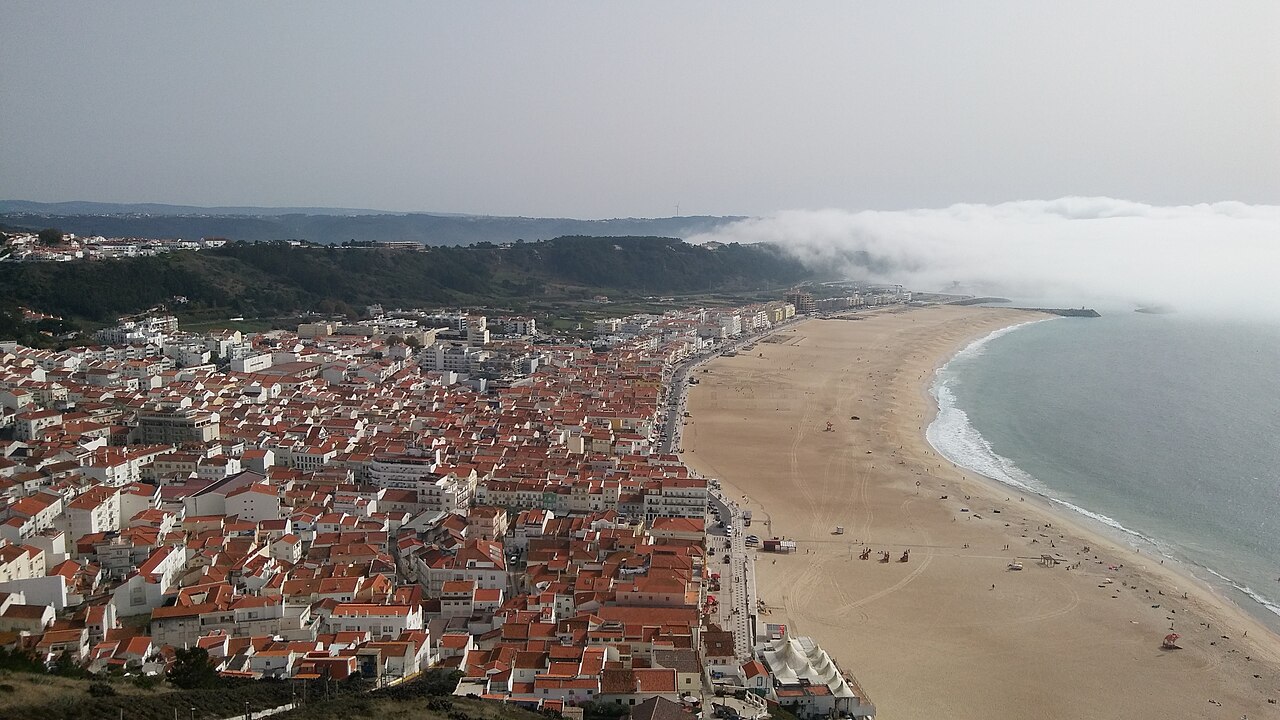
Nazaré is a traditional fishing town with a long crescent beach, made world-famous by the giant waves of Praia do Norte: the official world record for surfing (26.21 metres, ridden in 2020) stands here, and bigger waves have been measured that still await ratification. Take the funicular up to the Sítio, the old upper town, for the view from the Suberco over the bay, and walk on to the lighthouse on the fort where the big waves break.
Practical: park below and take the funicular to the Sítio; the giant waves are mostly a winter spectacle, in stormy seas. Plenty of fish restaurants below. Ten minutes on lies the shell-shaped bay of São Martinho do Porto, and the UNESCO monastery of Alcobaça is a short detour.

8. Óbidos
Óbidos is one of the best-preserved medieval towns in Portugal: white houses trimmed in blue and yellow, winding lanes full of bougainvillea and a complete town wall with a castle that is now a pousada. Walk the walls around the town, taste a ginjinha (cherry liqueur) from a chocolate cup and browse the bookshops. An atmospheric last stop; from here it is under an hour on the A8 to Lisbon.
Practical: park outside the walls (driving inside is largely prohibited) and walk in through the Porta da Vila; early or late in the day is quietest. Allow one to two hours.
Inland past the monasteries
The inland route trades the ocean for the great stories of central Portugal. You leave the A1 as early as Mealhada for the walled forest of Buçaco with its fairy-tale palace, and drive via the university city of Coimbra into the Serra da Lousã, where the schist village of Talasnal clings to a wooded slope. Then three heavyweights follow in quick succession: the Templar stronghold of Tomar, the sanctuary of Fátima and the monastery of Batalha. Three UNESCO World Heritage Sites, a world-class pilgrimage site and a mountain village, in one drive.
Allow more driving time than the kilometres suggest: between Coimbra and Tomar you spend nearly two hours on winding back roads, the finest and slowest part. The start (Porto to Mealhada) and the finish (Batalha to Lisbon) are deliberately motorway, or this would not fit in a day. In reverse, you start with Batalha in the morning light and end with the low sun over the Buçaco forest.
The 6 stops inland

1. Buçaco
The Mata Nacional do Buçaco is a walled forest of ancient and exotic trees, once laid out around a Carmelite monastery, with chapels, fern valleys and the Fonte Fria water staircase. At its heart stands the Palace Hotel do Buçaco, a neo-Manueline palace from the end of the nineteenth century, built as a royal retreat; it looks lifted from a fairy tale. Walk up to the Cruz Alta viewpoint; in clear weather the view stretches far across the plain.
Practical: you enter the park through a narrow toll gate (entry fee per car) and park by the palace. Allow an hour for the palace and the water staircase, more with the walk to the Cruz Alta.

2. Coimbra
Coimbra climbs in red roofs up a hill above the Mondego, crowned by the university founded in 1290, one of the oldest in Europe and a UNESCO World Heritage Site. Visit the lavish baroque Joanina Library and the university tower, wander the steep lanes of the old town and, if you can, listen to the fado de Coimbra, sung by men in black capes.
Practical: park down by the river and walk or take the little train up; for the Joanina Library buy a timed slot in advance. Allow at least half a day if you really want to go inside.

3. Talasnal (Serra da Lousã)
Talasnal is the best known of the aldeias do xisto, the schist villages of the Serra da Lousã: lanes of grey-brown slate stacked against a wooded mountainside, once all but abandoned and now lovingly restored, with a few small restaurants and guesthouses. The climb up from Lousã is a mountain lane of hairpins and valley views; down by the stream you pass the little castle of Lousã.
Practical: park on the small lot below the village and walk the last stretch; the lanes themselves are car-free. The restaurants open at weekends; on weekdays everything may be closed.

4. Tomar
Above Tomar towers the Convento de Cristo, founded in 1160 by Gualdim Pais as a Templar stronghold and later the headquarters of the Order of Christ, the order behind the Portuguese voyages of discovery. Inside wait the Charola, an octagonal Templar chapel modelled on the Holy Sepulchre in Jerusalem, and the famous Manueline window, perhaps the most richly carved window in Portugal. The town below on the Nabão is good for lunch.
Practical: drive up and park at the convento; tickets on site or online. Allow ninety minutes to two hours.

5. Fátima
Fátima is one of the largest Marian pilgrimage sites in the world, born of the apparitions three shepherd children reported here in 1917. On the immense esplanade stand the white basilica with its colonnade and, opposite, the modern Basílica da Santíssima Trindade; the heart is the small Capelinha das Aparições, built where the apparitions were reported. Even without faith, the scale and the silence make an impression.
Practical: large car parks around the sanctuary; an hour covers the esplanade and the chapel. Around 13 May and 13 October hundreds of thousands of pilgrims arrive: impressive, but not the moment for a quick stop.
6. Batalha
Batalha Monastery rose after the Battle of Aljubarrota (1385), the fulfilment of a vow by King João I for his victory over Castile; construction ran for nearly two centuries. Outside it is a riot of pinnacles and flying buttresses; inside, João and his English queen Philippa lie hand in hand on their tomb. Most famous of all are the Capelas Imperfeitas, an octagonal funerary chapel that was never finished and stands open to the sky.
Practical: park next to the monastery; the church is free, the cloisters and the Unfinished Chapels are ticketed. The last stop before the final run to Lisbon.
The fastest route or the most beautiful route
The A1 takes you from Porto to Lisbon in just over three hours, but costs about 25 euros in tolls (2026 tariff) and shows you mostly asphalt. Our two routes deliberately take the beautiful way: the coast or the interior. Longer, but with views, villages and stops. The motorway is never far away: at Aveiro, Coimbra, Leiria or Óbidos you can rejoin the A1 or A8 whenever time runs short. Got two days? Drive out along the coast and back inland.
Practical: rental car, tolls, season and vehicle
Rental car and one-way: within Portugal, collecting a car in one city and returning it in another is normal and usually free or cheap with the big rental firms. Expect a modest one-way fee and check it in advance; it is nothing like a cross-border drop-off, which often costs hundreds of euros.
Tolls: on 1 January 2025 Portugal abolished tolls on many motorways (the A22, A23, A24 and A25 among them), but the roads on this corridor stayed paid: the A1, A8, A14, A17 and A29. The coastal A17 and the A29 have no toll booths, only number-plate cameras. So rent a toll transponder (Via Verde) with the car and everything is charged automatically. The good news: the coastal route runs almost entirely on toll-free N-roads until Óbidos; only the final stretch on the A8 is paid. Note: per leg, Google Maps sometimes picks the parallel toll road (A29, A17) when it is a few minutes faster; switch on "Avoid tolls" or tap the grey alternative and you are back on the coast. Inland you mainly pay on the A1 up to the Mealhada exit and on the final run into Lisbon.
Best time to travel: May, June, September and October are ideal. In July and August the coastal villages are full; start early. The giant waves of Nazaré are a winter spectacle, in stormy seas, and around the pilgrimage days of 13 May and 13 October Fátima is impressive but extremely busy.
Vehicle: the Estrada Atlântica and the mountain road up to Talasnal are a joy in a convertible or on a motorbike. An ordinary rental car does them just as well; with a camper, mind the narrow core of Óbidos, park below the village at Talasnal, and note that the Buçaco forest has a narrow toll gate at the entrance.
Fuel: fill up before you return the car (returning it full is the rule with most firms). There are petrol stations near both airports.
Reviews from drivers
Reviews appear here with vehicle, experience and month of the drive. A score cannot be bought here, and this stays empty until someone has really driven it.
Share this route or save it
Share this drive with whoever should drive it
Or email it to yourself, for the road
Email this route to yourselfFrequently asked questions
What is the most beautiful route from Porto to Lisbon?
There are two. Along the coast via Senhor da Pedra, Aveiro, Costa Nova, Praia de Mira, Figueira da Foz, São Pedro de Moel, Nazaré and Óbidos (approx. 370 km). Or inland via Buçaco, Coimbra, Talasnal, Tomar, Fátima and Batalha (approx. 445 km). You open both above with every stop in Google Maps.
How long does the drive from Porto to Lisbon take?
On the A1, just over 3 hours. The coastal route is about 5 h 45 of pure driving, the inland route about 7 hours; with the stops, either route fills a day, or better two days with a night halfway.
Coast or inland: which should I choose?
For sea, beaches and photo stops, take the coast; it is also the easier day. For monasteries, history and quiet back roads, go inland: three UNESCO sites plus Fátima. With two days, do both: out along the coast, back inland.
Do you pay tolls between Porto and Lisbon?
On the A1 you do: about 25 euros for a car (2026 tariff). Since 1 January 2025 many Portuguese motorways are toll-free, but not the ones on this corridor (A1, A8, A14, A17, A29). The coastal route runs almost toll-free on N-roads until Óbidos; only the final stretch on the A8 is paid. Rent a toll transponder: the A17 and A29 only have number-plate cameras. For the coastal route, switch on "Avoid tolls" in Google Maps and the app follows the toll-free coastal roads by itself.
Can you drive a rental car from Porto to Lisbon and drop it there?
Yes. Within Portugal such a one-way trip is normal and usually free or cheap with the big rental firms. Check the one-way fee and whether you drop off at the airport (LIS) or in the city; that can affect the price.
What is the Estrada Atlântica?
The scenic coast road (N242) through the Pinhal de Leiria, the centuries-old royal pine forest between Figueira da Foz and Nazaré. The forest largely burned in October 2017 and is still young and low, but the road itself, past São Pedro de Moel and the Penedo da Saudade lighthouse, remains the finest toll-free stretch of the coastal route.
Is Fátima worth the detour?
It is not even a detour: Fátima lies on the inland route, between Tomar and Batalha. The sanctuary with its immense esplanade grew out of the 1917 apparitions and is one of the largest pilgrimage sites in the world; even without faith, the scale impresses. Allow an hour.
Where do you stay overnight halfway between Porto and Lisbon?
On the coastal route: Nazaré (waves and fish restaurants) or the walled town of Óbidos for an atmospheric evening. Inland: Coimbra for the university city or Tomar on the Nabão. With one night, either route becomes two easy days.
Can you open the routes in Google Maps?
Yes, free. Pick your route and direction above; Google Maps opens with every stop already in it. There is also a GPX per drive for Garmin, Komoot or TomTom.
What we deliberately leave out
Peniche and the Berlengas islands are gorgeous, but a day trip in themselves. Sintra and the Cascais coast belong to your Lisbon days; squeezed into this drive they sell themselves short. The Serra da Estrela, the highest range of mainland Portugal, belongs to a very different route. And Alcobaça we no longer leave out: that UNESCO monastery sits minutes off the coastal route, see the tip at the coastal stops.